


Let’s be honest. Nobody camps out on a sidewalk for three days to buy a washing machine. Nobody gets a tattoo of the Dell logo on their forearm. And I have yet to meet a human being who got into a fistfight at a Thanksgiving dinner defending the honor of their Hewlett-Packard printer.
But Apple? That’s different.
For the last few weeks, I’ve been wading through a swamp of internal memos, marketing strategies, and psychiatric-level sales scripts to understand how a computer company morphed into a modern religion. We look at the fruit, but we rarely look at the root system.
Heaps of data tell me one thing: Apple’s success has almost nothing to do with gigabytes, megapixels, or battery life. If you’re reading this on an iPhone, you didn’t buy a phone. You bought a membership card to a very expensive, very beautiful club.
Here is the anatomy of the cult.
1. The rebel with a Trust Fund

To understand the Apple psyche, you have to go back to the narrative arch they’ve been building since the Reagan administration.
Every cult needs a devil. A "Them." In the early 80s, "Them" was IBM — the beige, faceless, corporate Big Brother. When Ridley Scott filmed the famous 1984 commercial for the Macintosh, he wasn’t selling a computer; he was selling a sledgehammer to smash the state. It was brilliant positioning. It told the consumer: "If you buy IBM, you are a drone. If you buy us, you are a revolutionary."
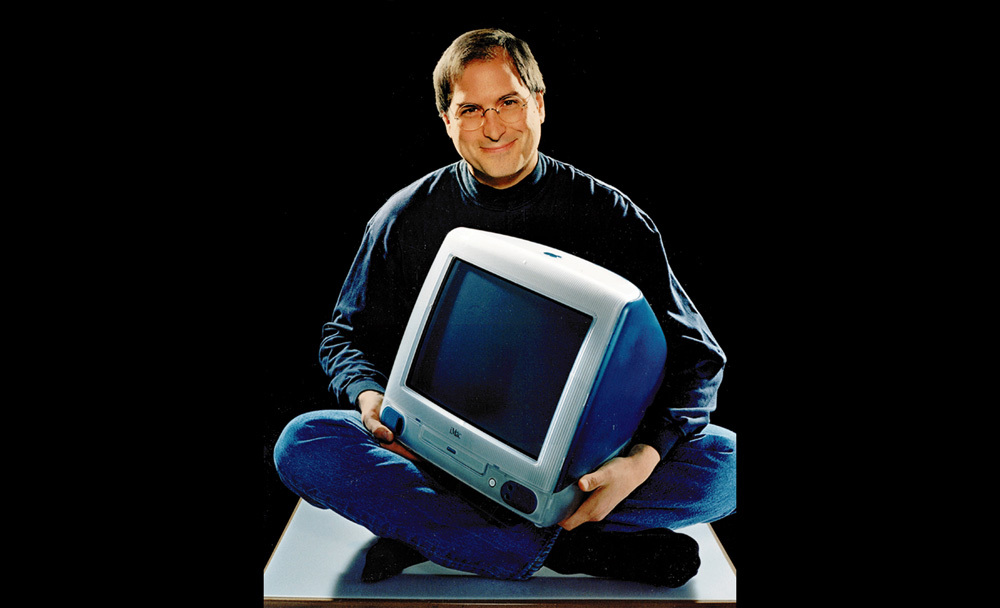
Fast forward to 1997. The company was bleeding out. Steve Jobs returned, not as a CEO, but as a sort of high priest in a mock turtleneck. He looked at the balance sheet, realized they couldn’t win on specs, and doubled down on the theology.
Enter the Think Different campaign.
This is where the genius (and the manipulation) kicks in. They stopped showing computers. Instead, they plastered billboards with faces of Einstein, Gandhi, Lennon, and Picasso. The message was subtle but devastatingly effective. It suggested that by simply purchasing a Mac, you were spiritually aligned with the greatest minds of the 20th century.
It was a pivot from hardware to identity. Jobs realized that in a noisy world, people don’t remember RAM; they remember how you make them feel about themselves. Today, the "enemy" has shifted from IBM to the chaotic fragmentation of Android or the corporate drabness of Microsoft, but the story is the same: We represent the creative class; they represent the mediocrity of the masses.
The irony, of course, is that Apple is now the most valuable company on earth. They are the Big Brother. But the marketing is so good that buying the same phone as 200 million other people still makes you feel like a non-conformist.
2. The Dictatorship of Simplicity
When Jobs came back in ’97, Apple was selling something like 350 different products and variations. It was a mess. It was the tech equivalent of a Cheesecake Factory menu — too many options, and none of them particularly good.
Jobs took a metaphorical chainsaw to the product line. He killed 70% of it. He drew a simple 2x2 matrix on a whiteboard: Consumer vs. Pro, Desktop vs. Portable. If a product didn't fit in one of those four boxes, it was dead.
This is what I call "The Dictatorship of Simplicity."
Most companies, like Dell or HP, suffer from the fear of missing out. They flood the market with cheap plastic variations to catch every possible customer. Apple went the other way. They created an artificial scarcity of choice. They saved us from "analysis paralysis."
But it goes deeper than just fewer products. It’s about control.
Take the design philosophy. In most companies, engineers build a machine, and then designers try to wrap a plastic skin around it to make it look decent. At Apple, Jony Ive and the design team dictated the reality. They demanded unibody aluminum chassis — milled from a single block of metal. It wasn’t just for aesthetics; it was a manufacturing flex that required inventing entirely new production processes.
And then there are the missing buttons. Jobs famously hated on/off switches. He wanted devices that just "slept." It sounds trivial, but it’s a psychological conditioning. It removes the mechanical nature of the machine and makes it feel organic. No instructions needed.
It’s arrogant, really. They don’t give you what you want (remember the headphone jack?); they give you what they decide you should have. And we thank them for it.
3. The Walled Garden (or: Hotel California)
If the marketing is the bait, the ecosystem is the trap. In Silicon Valley parlance, they call it the "Walled Garden." I prefer to call it "The Golden Handcuffs."
Unlike Google or Microsoft, which spread their software across thousands of devices like a virus, Apple insisted on owning the "whole widget." Hardware, software, services.
On the surface, this provides that magical "it just works" experience. You take a photo on your phone, it’s on your iPad. You copy text on your Mac, you paste it on your iPhone. It’s seamless. It’s seductive.
But the dark side of integration is "Lock-in."
Leaving the Apple ecosystem is designed to be painful. It’s a messy divorce where you lose the custody of your digital soul. If you switch to Android, you don’t just lose a phone; you lose your iTunes purchases, your iCloud syncs, and your social standing.
Let’s talk about iMessage. That blue bubble vs. green bubble situation isn’t an accident. It’s a social weapon. Jobs went on record saying he didn’t want to make life easy for people leaving the ecosystem. By keeping iMessage exclusive, they turned Android users into second-class citizens in group chats. It’s peer pressure weaponized as code.
You can check out any time you like, but you can never leave.
4. Psychological Warfare at the Genius Bar
Here is where the investigation got interesting. I dug into the retail strategy.
The Apple Store isn’t a shop. It’s a temple. Ron Johnson and Jobs designed them as "town squares." But behind the glass staircases and maple tables, there is a strict psychological script running.
I looked at leaked training manuals for the "Geniuses." These aren't just tech support kids; they are trained in empathy maneuvers that would make a hostage negotiator proud.
They are forbidden from using negative language.
Your computer didn’t "crash"; it stopped responding.
There isn’t a "bug"; there is a "condition" or a "situation."
It’s Orwellian Newspeak applied to consumer electronics.
The most fascinating tool in their arsenal is the "Three Fs" technique: Feel, Felt, Found.
When a customer complains — say, about the astronomical price — the Genius is trained to say:
"I understand how you feel. Many other customers felt the price was high too. But they found that the value over five years made it worth it."
It neutralizes the objection by validating your emotion, then pivoting to a new reality. It’s not sales; it’s therapy. And it creates a level of trust that allows them to upsell you a $50 silicone case without you blinking an eye.
5. The Art of the Secret

Finally, there is the silence.
Most companies scream for attention. They announce products months in advance to please shareholders. Apple operates like the CIA.
They created a culture of secrecy that turned the lack of information into a commodity. By saying nothing, they forced the world to speculate. The "Rumor Mill" is essentially a free marketing department worth billions. Every leak, every "lost prototype" left in a bar, every whispered speculation creates a vacuum that the media rushes to fill.
And then, the Keynote.
Jobs treated these presentations not as corporate briefings, but as theatrical performances. He generated a "Reality Distortion Field." I’ve watched footage of rational tech journalists cheering like teenage girls at a Beatles concert because a phone got a slightly better screen.
They create artificial scarcity at launch. Lines around the block? That’s not a supply chain failure; that’s social proof. When we see a line, our lizard brain tells us: Something valuable is there. I need it.
The Verdict
So, is Apple a cult?
Technically, no. But functionally? It ticks every box. They have a charismatic leader (the ghost of Jobs), a doctrine (Think Different), an enemy (the rest of the world), and a severe penalty for leaving the community (Green Bubbles).
They didn’t just build a better mousetrap. They convinced the mice that the trap was the only stylish place to live.
The brilliance of Brand Apple isn't in the silicon. It’s in the understanding that we are irrational, emotional creatures who desperately want to belong to the "chosen ones." They sold us the feeling of being special, mass-produced by the millions.
And honestly? I’m typing this on a MacBook Air, and I’m probably going to buy the new iPhone next month. The Kool-Aid just tastes that good. ~
Sources:
- Burns, Chris. "Apple Genius Training Student Workbook 'Leaked'." SlashGear, August 28, 2012.
- Thomson, Iain. "Leaked Genius Bar manual shows Apple's smooth seductions." The Register, August 29, 2012.
- Dudovskiy, John. "Apple Organizational Culture - Secrecy and Maximum Benefit from Human Resources." Research Methodology, July 5, 2023.
- Esslinger, Hartmut. Keep It Simple: The Early Design Years of Apple. Stuttgart: Arnoldsche Art Publishers, 2014.
- Isaacson, Walter. Steve Jobs. New York: Simon & Schuster, 2011.
- Kahney, Leander. Jony Ive: The Genius Behind Apple's Greatest Products. New York: Portfolio/Penguin, 2013.
- Kahney, Leander. Tim Cook: The Genius Who Took Apple to the Next Level. New York: Portfolio/Penguin, 2019.
- Lashinsky, Adam. Inside Apple: How America's Most Admired—and Secretive—Company Really Works. New York: Grand Central Publishing, 2012.
- Merchant, Brian. The One Device: The Secret History of the iPhone. New York: Little, Brown and Company, 2017.
- Schlender, Brent, and Rick Tetzeli. Becoming Steve Jobs: The Evolution of a Reckless Upstart into a Visionary Leader. New York: Crown Business, 2015.
- Segall, Ken. Insanely Simple: The Obsession That Drives Apple's Success. New York: Portfolio/Penguin, 2012.
Join the discussion
This article has comments from our members. Sign in to read them and share your thoughts.
Join for free