


In the Silicon Valley Bible, there is a story of Original Sin.
The legend goes like this: In 1979, Steve Jobs, the pirate king, stormed into the Xerox PARC research center in Palo Alto. He saw the future — the mouse, the windows, the graphical interface. He looted the place, stole the ideas, and built the Macintosh, leaving Xerox to die in the dust of its own brilliance.
It’s a great story. It paints Jobs as a ruthless genius and Xerox as a tragic victim.
There is just one problem: It’s complete nonsense.
The "heist" wasn't a theft. It was a business transaction. And the reason Xerox failed wasn't because they were robbed; it was because they were arguably the worst capitalists in the history of capitalism.
Here is the autopsy of the deal that changed the world.
1. The Price of an Open Kimono
Let’s kill the "theft" myth immediately. Jobs didn't break in at night. He bought a ticket.

In 1979, Apple was the hottest startup on the planet. Xerox, an East Coast copier company, desperately wanted in on the IPO. Their venture arm approached Apple to invest.
Jobs, knowing exactly who he was dealing with, made a counter-offer that would make a poker player sweat: "I will let you invest $1 million in Apple, but only if you open the kimono at PARC. Show me everything."
Xerox leadership agreed. They bought 100,000 shares of Apple for about $10 each. A year later, when Apple went public, that investment was worth $17.6 million.
Xerox made a 1,700% return on the "theft." This wasn't a robbery; it was the most profitable museum tour in history.
2. The $300 Mouse vs. The $15 Mouse
The real tragedy of the myth is that it ignores the engineering miracle Apple pulled off.

Critics say Apple "copied" the mouse. Sure, they saw a mouse at PARC. But let’s look at that mouse.
The Xerox mouse had three buttons. It cost $300 to manufacture. It broke easily. It rolled on complex ball bearings that got clogged with dust. It was a piece of lab equipment, not a consumer product.
Jobs didn't copy it. He went to industrial designer Dean Hovey and gave him a spec that sounded impossible: "I want a single-button mouse. It needs to cost $15 to make. And it needs to work on my jeans."

Apple’s engineers had to reinvent the mechanism from scratch. They replaced the complex bearings with a rubber-coated steel ball and optical encoders. They turned a fragile, expensive scientific instrument into a rugged, cheap tool that a child could use.
That is productization. And frankly, it is much harder than coming up with the initial idea.
3. The Window that Didn't Exist
Here is my favorite part of the story. It proves that Apple’s engineers were actually better than the wizards at PARC.

During the demo, Bill Atkinson (one of Apple’s lead programmers) stared at the Xerox Alto screen. He saw windows overlapping each other. He thought he saw the computer redrawing the hidden parts of the windows in real-time.
He went back to Cupertino and spent months writing agonizingly complex math to replicate it. He invented "Regions" — a way to manage overlapping graphical elements efficiently.
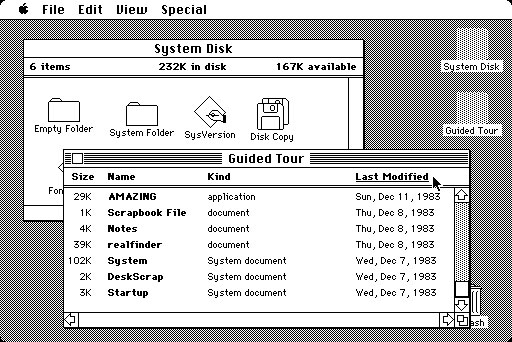
Months later, after the Mac launched, Atkinson met the Xerox guys. They were stunned. "How did you do that?" they asked.
It turned out, the Xerox computer couldn't actually do what Atkinson thought he saw. Their windows didn't redraw correctly; they just dropped pixels.
Atkinson had hallucinated a feature and then invented the math to make it real, simply because he didn't know it was impossible.
4. The Idiot-Savant Syndrome
So why did Xerox fail? Why didn't they own the PC revolution?

The answer lies in the culture of PARC.
The researchers there were brilliant, but they suffered from what historian Randall Stross calls "Idiot-Savant Syndrome." They were geniuses in the lab, but morons in the market.
They built computers for themselves. Their prototype, the Alto, would have cost $40,000 if sold commercially. They didn't care about cost. They didn't care about memory limits. They famously had a slogan: "Use What We Build." Which meant they only built things for PhDs in Computer Science.
When Xerox finally tried to sell a commercial computer (the Star in 1981), it cost $16,000, was painfully slow, and couldn't talk to other computers easily. They sold 30,000 units. It was a disaster.

The Xerox management on the East Coast ("toner heads," as the Valley called them) viewed computers as just fancy copiers. They had the future in their hands, but they were trying to figure out how to make it print better memos.
The Verdict
Picasso said, "Good artists copy, great artists steal."
Steve Jobs loved that quote. But in the case of Xerox, it’s the wrong quote.
The better quote comes from Thomas Edison: "Vision without execution is hallucination."
Xerox PARC was hallucinating. They had the vision, but they had zero ability to execute a consumer product. They were an academic nursing home for great ideas.
Apple didn't steal the future. They rescued it. They took a clunky, $40,000 concept and beat it into a $2,500 appliance that changed the world.
So, let’s stop crying for Xerox. They got their $17 million. They got their name in the history books. But they didn't get the revolution, because you can't own a revolution if you keep it locked in a lab. ~
Sources
- Isaacson, Walter. Steve Jobs. New York: Simon & Schuster, 2011.
- Stross, Randall E. Steve Jobs & The NeXT Big Thing. New York: Atheneum/Macmillan, 1993.
- Lammers, Susan. Programmers at Work. Redmond, WA: Microsoft Press, 1986.
- Smith, Douglas K., and Robert C. Alexander. Fumbling the Future: How Xerox Invented, Then Ignored, The First Personal Computer. New York: William Morrow, 1988.
- Goldberg, Adele. "The Smalltalk-80 System Release Process." In Smalltalk-80: Bits of History, Words of Advice, edited by Glenn Krasner. Reading, MA: Addison-Wesley, 1983.
- Thacker, C. P., et al. "Alto: A Personal Computer." In Computer Structures: Principles and Examples, edited by Daniel P. Siewiorek, C. Gordon Bell, and Allen Newell. New York: McGraw-Hill, 1982.
Join the discussion
This article has comments from our members. Sign in to read them and share your thoughts.
Join for free